Claudia's Blog

Confessions of an art cheat

I was at the County Show in the rain last week.  Not through choice; I wandered round the show with the same bemused look on my face that a farmer might have if he stumbled into a boat show.  There were children on ponies, large bulls being led round a field accompanied by men with clipboards, and ladies with high heels drinking pimms in the mud. 

I was there demonstrating watercolours in the Learning Pembrokeshire tent, where the great British (or Welsh) public could find out all the marvellous subjects on offer at adult education classes.  Generally people are interested and delightful when I splash paint around in public but there’s always an exception.  I was painting a scene from my sketchbook, not expecting wonders as the drizzle coming into the tent was stopping the paint from drying.  A chap peered at what I was doing and announced, ‘That’s cheating!’.  Eh?  I looked up at him, waiting for this expert to tell me where I’ve been going wrong all these years.  ‘You’re supposed to make it up out of your head’, he said, waggling a finger at me.  ‘It’s cheating copying from a drawing!’ .  In vain I told him it was my own drawing, and artists are often in the habit of going outdoors and… well, drawing things.  It’s what we do. 

I daren’t let him near my studio; he would probably tear up my tracing paper and use it as kindling to burn the light box.  Remind me never to admit to using reference images from google.  I realised that there was no point arguing and explaining that if you want to draw something and don’t know what it looks like, go and find out.  

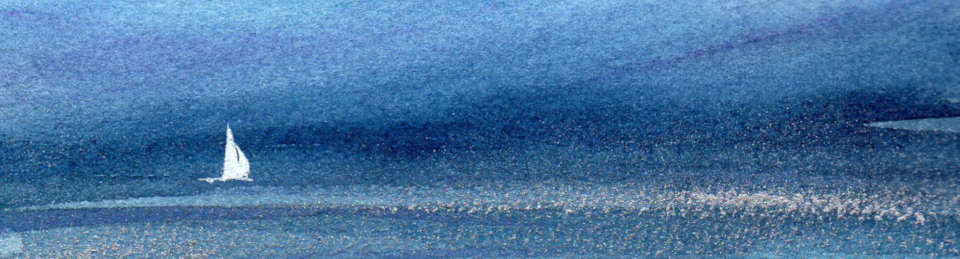
As it happens, I have been painting from the imagination recently, as a holiday from the relentless demands of  book illustration.  This was from a bigger piece called ‘Hand, heart, eye’, which, as it happens, are the three things David Hockney says you need to be able to draw.  The picture here is only an extract  – not because I’m trying to be arty but because I only have an A4 scanner.  Usually my big paint brushes only get used for getting the biscuit crumbs off my laptop keyboard, but I took myself off to a day’s painting workshop with the excellent Elizabeth Haines a few weeks ago, a great opportunity to get shaken out of my comfort zone.

Hand, heart and eye – I like that.  It’s the ‘heart’ element that takes a drawing beyond copying.

Alchemy and imperfection

Artistic people have the knack of making ordinary things beautiful.  Last week I went to a concert in Goodwick, at a church overlooking the bay.  It was an overcast evening, grey light on a grey sea and the breakwater cutting across the centre of the bay.  There was half an hour before the concert started and Elizabeth Haines (www.elizabethhaines.co.uk) was sketching the view.  Through her eyes and hand, the dull expanse of bay came alive in a swirling pencil sketch of subtle tones.  Half an hour later and the same alchemy was happening through the voice of baritone Richard Parry (www.dramaticsongrecital.co.uk) as he acted and sang his way through the cleverly composed musical drama ‘An Act of Piracy’.  Wonderful – he could have sung a shopping list and it would have sounded good.  It’s always a challenge to try and sketch moving figures, especially when they’re singing and acting,  but it’s fun to try – after all, I need the practice!  With apologies to Richard who is much better looking in the flesh that he is in my sketchbook.


Meanwhile, back in the studio:

Some people have bad hair days.  Illustrators have bad pencil days.  Sometimes I forget how to draw, which is rather inconvenient.  I looked at yesterday’s drawings and two, possibly three of them needed doing again.  There’s no excuse; sometimes you just know that pencil, hand and eye haven’t quite made the connection.  When this happens I doggedly finish the drawing, ignoring the voice in my head telling me not to bother as it’s going to end up in the bin.  This was the version I tried to persuade myself would do:


It won’t, of course.  You’ll have spotted that the arms are too long for a start and it just lacks a certain something.  In the bin it went, and I returned to the original reference sketch (drawn from a photo of James modelling for me, somewhat reluctantly).   Second attempt – that’s better.    In case you were wondering, the illustration is for a page about marine scientists conducting research.  Caption is: ‘Right, now the next question…..’

 Ah well, life’s a journey.  On my headstone I want the words “Bother, I was just getting the hang of it!”

Watching paint dry

If you’re not into watercolours I recommend a click of the mouse now before your eyes glaze over.  For those who find sketching outdoors strangely exciting and challenging, here’s another of my colour mixing rants.  It was the last day of term today for my art classes, and it’s become a tradition to escape the classroom and spend the time sketching in Llawhaden castle grounds.  Sketching outdoors refreshes the parts that copying photos can’t reach, as well as waking up your colour sense.  How do you paint a stone wall?  Is it light or dark?  Warm or cool?  It’s usually all these things, speckled with white patches of lichen just to make the task even more tricky. 

Letting patches of alizarin, cobalt and raw sienna blend on the page gets you the soft mixed shades of old stone.   Other variations of the three primaries could be used to get similar effects.  More blue in the shadows, more sienna in the sunny spots.  Plenty of white patches of paper left exposed for the lichen.  In the studio you can see what you’re doing, tubes are clearly labelled and there’s a nice big white palette (cunningly disguised as a ten pence white china plate from a charity shop) to mix puddles of colour in.  But when you’re sitting on a wobbly stool with the wind blowing and your pocket paintbox on your knee, it’s not so easy, especially when you look at the range of colours in the average ‘beginners’ sketching boxes.  Gill had 24 colours in her box, most of them unused and unusable.  Four shades of insipid pink, 4 blues all very similar but no windsor blue.  Umpteen sludgy browns, all indistuingishable.   Give it to your grandchildren and start again, I said.  You need the same colours in your field palette as you do in the studio, otherwise you might as well mix your colours blindfold.  Get half a dozen artists quality half pans in a paintbox and give yourself a chance.  The more limited the colour choices, the better your chances of consistency and remembering which colour does what.  Sketching outdoors is challenging enough, what with wind, weather, nowhere to put stuff, tourists getting in the way, getting a numb bum sitting on rocks, and insects landing on your sketchbook.  It’s tough out there, folks. 

So if all those pretty paintboxes with their dozens of obscure colours are all hitting the bins tonight, it’s all my fault.  My own paintbox is messy, but it works.  It’s still got more colours in it than I tend to use, but generally it’s easy to plonk the brush in roughly the right place when working at speed. 


Colours most used?  Raw sienna, cobalt blue, windsor blue, ultramarine, alizarin, aureolin, light red, cobalt violet, cadmium yellow.  So that’s two reds, two blues, three yellows and a voilet.  The palette could do with a wash, though, couldn’t it.  Glass of wine first, I think.

Kittiwakes on Dinas Head

Perspective in art is a glorious illusion, something I’ve been using haphazardly for years in my paintings in a ‘hoping for the best’ kind of way.  But the great thing about teaching something is that you have to learn about it first, so over the last few months I’ve been paying more attention.  Perspective in art is defined as ‘the appearance of things relative to one another as determined by their distance from the viewer’.  Everyone knows that, but what surprises people is the extent to which distance shrinks everything.  How many student paintings have you seen with giant sheep in a distant field, or an enormous cottage on a hillside?

I was trying to explain this in the classroom on Wednesday and, as is often the case, practical examples speak loudest.    We were talking about figures in a painting, and how as they recede into the distance, the eye level remains the same but the feet move in relative to the foreground figures (assuming that all the figures are standing on level ground and are the same height, of course).

Sheila stood at the back of the room; Gill at the front.  There was probably about 30’ between them, so Sheila appeared smaller than Gill.  So far, so obvious.  But how much smaller, do you think.  Have a guess.  Their eye levels remained the same as they were similar height, so if you drew a line along Sheila’s feet, where on Gill’s body did they line up?  Would you believe me if I said that Sheila’s feet lined up with Gill’s waist?  She was exactly half her size, and only the width of a room apart.  To be able to draw, you need to remove your perspective goggles, shut your brain up and treat everything you see as if it was two dimensional. 

That’s enough of that.   I did take time away from the drawing board today for a magical walk around Dinas Head.   Kittiwakes hovered on the clifftops;  I recognised them having spent several days last week studying and drawing seabirds for chapter three.   Why does knowing the name of something enhance our appreciation of it?  I’ll have a think about that one, preferably with a glass of Chardonnay in hand.

busman’s holiday!

Reflections on drawing

Several days of thinking ‘must update my blog’ usually pass before I get round to it.  The plan is always to sit down in the evening with a clear head and a glass of wine and get inspired.  This rarely happens.  The glass of wine always happens, but not the clear head, or even the inspiration.  Today I’ve been wrestling with the current page of my book about the oceans; trying to find a fun way to put across the problems of over-fishing and the environmental impact is taxing to say the least.  I did do a sketch of a fish in a tutu – the fairy cod-mother – well, it’s a start. 

I also had a slight diversion from the task in hand which was rather enjoyable, in the form of a phone call from Julia Jones in Essex, skipper and owner of Arthur Ransome’s original ‘Peter Duck’ ketch amongst many other talents.  Would I be interested in producing an image for the cover of her forthcoming novel ‘The Salt Stained Book’?    I do love a commission that’s just up my creek!  First of course I needed to read the book – this was no hardship as it’s a great story, a modern and quite edgy version of ‘Swallows and Amazons’.  I’m still working on the design, but there’s more about Julia and her various doings on www.golden-duck.co.uk.

More distraction from the business of getting Chapter Two done came my way on Friday as I was booked for an afternoon drawing lesson with the U3A group in Neyland.  It’s always great fun teaching at U3A; everyone speaks their mind and is very up front about what they want to learn. Usually my prepared lesson descends into happy chaos and I just go with the flow.  This was no exception and turned into a bit of a rant about the reason for wanting to draw in the first place – as a means of connecting to somewhere special, spending time, taking the trouble to look properly.  Contrary to what the tv would have us believe, not everthing in life is a competition; we would always like to improve the way we do things, but sketching is a personal process not open to criticism.  Do enough of it and it will get better all by itself.  Life is too short to be frozen into inactivity by the fear of not being good enough!

Here’s my own sketch of a sunlit moment on East Trewent Head on Sunday, when I decided that I’d had enough of writing about the sea and trying to draw it when I hadn ‘t actually been to look at it for months…..

The left side of the page hasn’t scanned as well as the right….. use your imagination!

That’ll do for now… there’s half a glass of wine left and I’m listening to ‘Pentangle’ on cd while the family are involved in something noisy and American on tv in the other room.

Learning, singing and a Tenby lugger


February on Planet Claudia has good and bad qualities.  On the one hand it’s still cold enough to wear three layers plus mittens, along with the cloud of guilt permanently hovering at not having started any work on the boat yet, let alone tidying up the garden.  On the plus side, this is the month for my two day singing workshop with Maddy Prior and Abbie Lathe at the fabulous Rhosygilwen concert hall near Cardigan.  At the risk of repeating the content of last year’s blog, there’s something truly inspirational about harmony singing.  Knowing little (well, nothing) about music theory, it’s a mystery to me how three or four parts of a song can come together and produce something that’s bigger and better than all the individual pieces.   

Now I’m as guilty as anyone of watching  tv talent shows occasionally, but they do reinforce the myth that people are either extremely talented or completely hopeless.  In other words, if you’re not Somebody, you’re Nobody.  No wonder the cult of celebrity has young people mesmerised; nobody wants to be themselves anymore, they want to be somebody else.  Somebody prettier, thinner, richer, famous.   Most of us are hungry for song, but few will sing for pleasure; we’d rather stay silent and plug in the ipod.   Whilst nothing beats the joy of listening to professional musicians singing live or on cd, that’s only the part of what music is for.  It’s a revelation to find that everyone’s voice can be coaxed out and improved, with technique and a bit of work.  Even mine.   According to Abbie, it’s about supporting your own voice, silencing the inner critic, and trying to be the best you can be, rather than giving up because you can’t sing like somebody else.  In singing as in life, nobody else can make a success of being you except you.

Oops, that wasn’t meant to be a lecture. 

Learning and teaching are both satisfying experiences.  As well as the regular Wednesday watercolour classes this week, I also helped Chris Stephens deliver a one day workshop to schoolteachers.  It’s not often my skills as artist and maritime historian are both required at the same time, but the content of the workshop was about weaving Welsh culture and heritage into the school curriculum in as many learning styles as possible.  It was a hugely enjoyable day; my main input was a session teaching the teachers about the Tenby lugger by learning how to paint one in watercolour.  Much hilarity followed, but everyone acquitted themselves well, even those unfamiliar with watercolour techniques. 

paddle-your-own-canoe-workshop-low-res1

Why a Tenby lugger?  For one thing, they’re easier to draw than a larger ship such as a schooner or brig, and it’s topical in that the ever valiant and resourceful West Wales Maritime Heritage Society is about to begin restoring the last remaining example of a Tenby lugger in Pembroke Dock.  Have a look at their website www.wwmhs.org.uk to find out more, especially if you have any ideas for fundraising. 

Finally, we’re off to the RYA Volvo Dinghy Show next weekend, so the house is filling up with boxes of  ’stuff’ to take.  It’s an enjoyable show, with a great atmosphere, and we’re looking forward to catching up with everyone.   New for this year will be more jewellery, the new log books and sketch books and of course a new fridge magnet or two!

 born-to-sail

Henry’s rocky cove

In August 1485, so the story goes, Henry Tudor sailed over from exile in France and landed at Mill Bay in Pembrokeshire.  Gathering support along the way, he then stomped eastwards, beat up Richard III in the Battle of Bosworth and crowned himself Henry VII.  The rest, as they say, is history.  Now, here’s the question – why did he land in Mill Bay?  We know why he landed in Pembrokeshire; because he was born in Pembroke Castle and wanted to gather men from Wales as he marched, and the English were keeping a watchful eye on the south coast in case he tried to sneak in that way. 

Mill Bay looking southeast out of the haven

Mill Bay looking southeast out of the haven

I went to Mill Bay last weekend, a pleasant half hour stroll along the coast path from the car park on St Ann’s Head.  It’s the first cove on the left as you sail into Milford Haven.  The path dips down to the cove where a small valley tips a stream onto a rocky foreshore.  You could land a small boat there, but I’d only attempt it in a very flat calm; negotiating the rocks and finding a flat piece of sand to beach would be tricky.  Perhaps there was more sand in Mill Bay in the 15th century.  Perhaps there was a stone pier.  But it’s still an odd choice, as another half an hour’s sail brings you to the glorious sheltered bay of Dale, which is about as perfect as an anchorage and sheltered landing place could be, and would have saved the would-be monarch from an hour’s tramp along the cliffs.  Apparently he sent some of his ships round to Dale, but he preferred to be put ashore at Mill Bay.  I bet he got his feet wet.

Even more sensible than Dale would have been to save another day’s march and take the tide further upriver, to his birthplace at Pembroke perhaps, or to Milford.  Even if the wind was unfavourable, the tide would have carried the fleet upriver very efficiently.  Perhaps he had a girlfriend on St Ann’s Head.  Perhaps he’d had enough of being afloat and was desperate to get ashore.  Perhaps nobody knows, but if you do, please let me know.  It’s always interesting to look at history from a seafarer’s point of view.


St Anne's Head - design for a postcard of Dale (not quite finished!)

St Anne's Head - design for a postcard of Dale (not quite finished!)

If Henry’s ship’s log was still around, I’d love to see it.  And talking of log books (ouch, what a contrived link!) and with a leap of imagination back into the 21st century, my newly designed Log Books for Little Ships are back from the printers – have a look at www.starfishbooks.co.uk for the details.  When I say the books are back from the printers, what I actually mean is that my studio floor has disappeared under several dozen boxes of pages and covers, so there’s just the small business of collating and binding them.   In the meantime I’m stepping over boxes to get to my drawing board.  Ho hum…

Not sketching weather for wimps…

Good things about being snowed in…… the village is muffled in silence and beautiful.  The path through the woods looks like a scene from The Lion the Witch and the Wardrobe.    Strangers out for walks are chattier than usual.  Can’t go very far so getting plenty of work done.

Bad things about being snowed in…… trying to type or draw with gloves on.  Not being able to drive anywhere.  Remembering what sailing in the sunshine is like – but only just.  Wondering if I’m going to make it to the introductory session of my watercolour classes in Haverfordwest tomorrow – probably not unless there’s a sudden thaw. 

just don't expect me to drive anywhere...!

just don't expect me to drive anywhere...!

I’ll admit it…. it’s December

silent-night

I’m not very good at winters.  From September onwards I wear so many layers of clothes that getting dressed in the morning takes ages, but I’m still permanently cold.  Bracing walks after a day at the drawing board are out of the question because it’s gone dark by then – and is usually raining too.  And I’m one of those grumpy people who hates any mention of  Christmas before December and I shout at the radio when they wheel out the cheesy Christmas pop songs.  I’m either turning into a grumpy old woman or I’m just a bit short of sunlight and vitamin D!

But now it’s mid December I’ll admit it, Christmas is imminent.  I can tell because I spend most of the time doing a wide variety of bits and pieces instead of getting stuck in to one big project.   There are Christmas commissions (this week including a wooden name plaque for a boat, a portrait of a Dunkirk Little Ship, and a sketch of a pilot cutter), as well as stocking up galleries and helping Perry sort out online orders.  Talking of  Christmas galleries, here’s a reminder to all you east coast dwellers to visit that unique emporium of all things nautical, Salty Dogs, brainchild of the inimitable Den Phillips.  This year it’s at 57 High Street Maldon so pop in if you get a chance; it just gets better each year.  Another east coast gallery I’m topping up for Christmas is the delightful Sea Pictures Gallery in Clare, Suffolk – not near the sea but that means all the more reason to buy seascapes!  Meanwhile, back here on the west coast I nipped over to Cardigan today to drop some work in at Frame byFrame, run by the inspirational Chloe and Emma. 

After new year I’ll change hats and be an illustrator again, but for the moment it’s good to make more space in the studio and get stuff out there.  Actually, in January I’ll also have my tutor’s hat back on as I’ve a full two classes of keen students waiting for me on a wednesday in Haverfordwest.  Great fun.

The image  above is called  ‘Silent Night’ and it’s one of the Christmas cards I designed for the Nancy Blackett Trust (www.nancyblackett.org).  Unsurprisingly, I don’t do winter sailing, but I know there are those that do!  Which reminds me, good luck to Geoff Holt setting off on his Atlantic Challenge today.  The lengths some people will go to to get some sunshine….. (www.geoffholt.com)

Knitters cast on and sailors cast off….

Now here’s a thing – I’ve never knitted and never will, having no affinity at all with anything that requires needles, whether knitting or sewing.  At school I was thrown out of the domestic science sewing class because I was so hopeless, and sent to do Latin instead.  Believe me, Latin was a doddle by comparison. But I do admire the colours and fabrics and textures of all sorts of wearable art, and love the idea of it.  A knitter called Brenda Dayne came to my studio exhibition last week and I discovered that she’s also a very skilled journalist and broadcaster.  She interviewed me and also fellow artist Linda Norris about our approach to art, to include in her series of podcasts on the theme of events and people within a 20 mile radius of her home.  Have a listen on www.cast-on.com – I don’t think it’s compulsory to be knitting whilst you listen!

I thought it was interesting that knitters cast on to begin their journey and sailors cast off.  All is connected….